
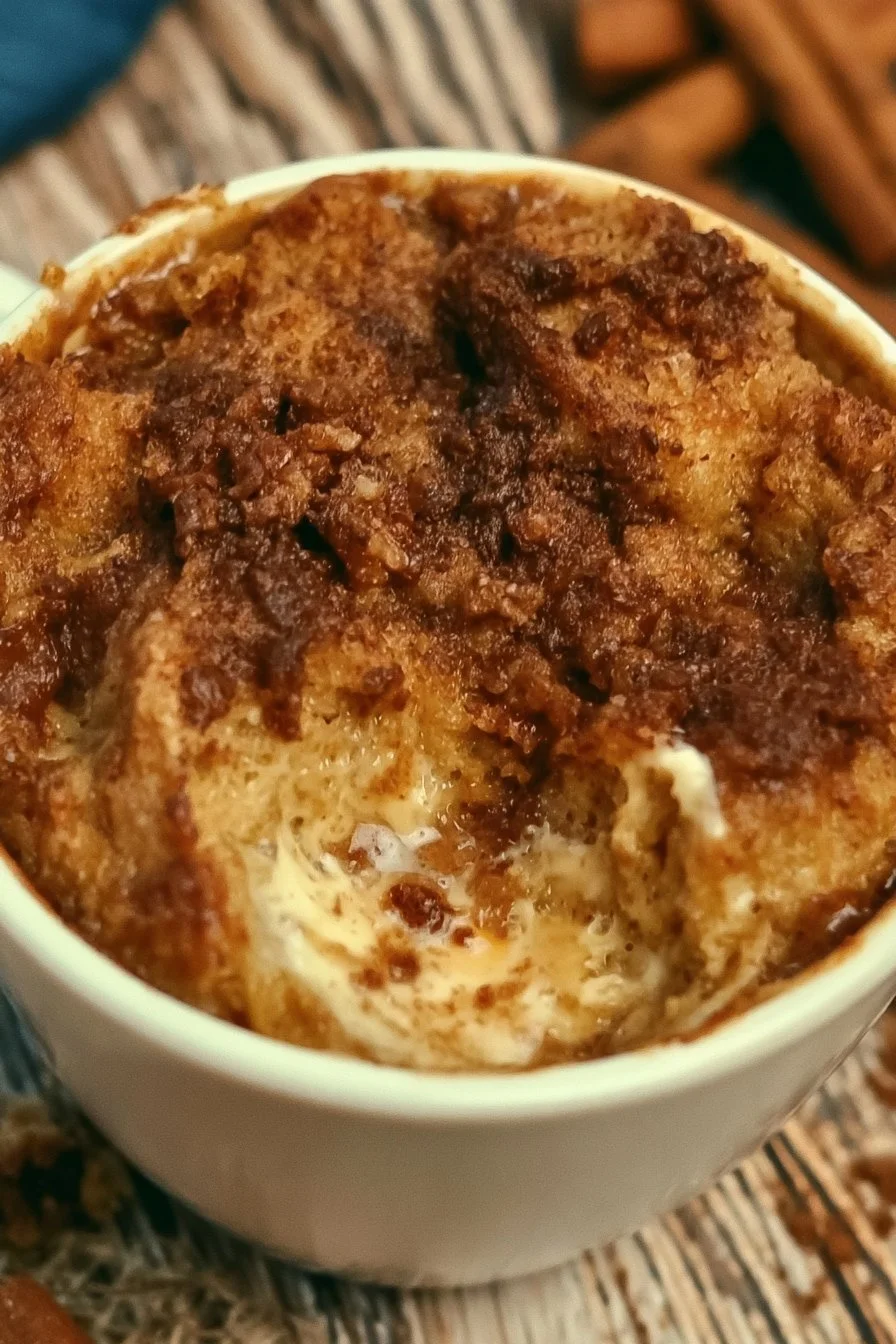
Air fryer mug coffee cake is a single-serving vanilla cake layered with cinnamon and brown sugar. It cooks in an oven-safe mug or ramekin at 350°F, with a short cooling period before eating.
The air-fryer bake takes about ten to twelve minutes, rather than the one-minute timing commonly used for a microwave mug cake. Use a wide heat-safe cup with enough room for the batter to rise.
On This Page
Why This Recipe Works
An egg gives this small cake structure, while oil keeps the crumb soft. Dividing the batter and cinnamon topping into two layers puts sweetness inside the cake as well as on top. A wide vessel helps hot air reach the center before the surface becomes too dark. Checking for wet batter gives a better result than using a fixed one-minute timer.
Ingredients
Use a twelve- to sixteen-ounce wide mug or ramekin explicitly rated for oven use at 350°F; a microwave-safe label alone is not enough. The cake uses three tablespoons flour, one egg, and two tablespoons oil. The separate cinnamon layer uses three teaspoons brown sugar, one and one-half teaspoons oil, and one-sixteenth teaspoon salt. Use up to half a teaspoon salt in the cake batter, choosing less for a lightly salted cake.
Cake Batter
- 3 tablespoons all-purpose flour
- 1/2 teaspoon baking powder
- 1/2 teaspoon salt, use up to this amount, to taste
- 1 tablespoon granulated sugar
- 1 large egg
- 2 tablespoons vegetable oil
- 1/2 teaspoon vanilla extract
Cinnamon Layer
- 1 teaspoon ground cinnamon
- 3 teaspoons brown sugar
- 1 1/2 teaspoons vegetable oil
- 1/16 teaspoon salt
How to Make Air Fryer Mug Coffee Cake
1. Choose the cup and blend the batter. Check that the oven-safe vessel fits securely inside the basket with space around it. Preheat to 350°F if the appliance manual requires it. Whisk flour, baking powder, granulated sugar, and salt in a small bowl, using only as much of the measured cake salt as suits your taste. Add the egg, two tablespoons oil, and vanilla, mixing until the dry flour disappears rather than beating for a long time.
2. Make a separate cinnamon mixture. Combine the cinnamon, brown sugar, one-and-one-half teaspoons oil, and tiny measured pinch of salt. Stir until the sugar is evenly damp and forms small clumps. Using the topping oil here keeps the flavoring mixture distinct from the cake batter. Brown sugar contributes a softer, richer cinnamon layer than sprinkling cinnamon alone over the surface.
3. Layer with room to rise. Spoon half the batter into the cup and scatter half the cinnamon mixture over it. Add the remaining batter, then the remaining topping. Keep the filled vessel no more than about two-thirds full; transfer to a larger oven-safe ramekin if necessary. The two equal layers make the measured topping easy to distribute without leaving an unflavored bottom half.
4. Air fry and let the center settle. Place the cup in the basket and cook at 350°F for ten to twelve minutes. Start checking at ten minutes: the top should be set, and a toothpick inserted into the cake portion should show crumbs rather than wet batter. Add short one- to two-minute intervals if needed for a deeper vessel. Use oven mitts to lift the hot cup and let it cool for five minutes before serving.
How to Serve
Serve the one-person cake in its cooled cooking vessel with a spoon. The cinnamon-sugar layers provide enough sweetness for a plain serving. If adding yogurt or fruit, wait until the cup is comfortable to handle so the topping stays cool.
Storage
The cake is best freshly cooked. Refrigerate a cooled leftover portion in a covered container within two hours and use within two days. Warm briefly before serving, following the vessel’s microwave or oven rating. Avoid moving a very cold ceramic cup directly into a hot air fryer because sudden temperature changes can damage some ceramics. See federal cold-storage guidance for refrigerated foods.
Tips and Variations
- Use an oven-rated vessel with room around it in the basket.
- Keep the batter below roughly two-thirds of the cup’s height.
- Divide both batter and topping into equal halves.
- Check the cake portion rather than a pocket of melted sugar.
Frequently Asked Questions
Does coffee cake contain coffee?
This version does not. The name refers to a cake often served with coffee.
Can I microwave it instead?
Microwave timing and texture differ from air frying. Use a microwave-specific mug cake recipe for that method.
Can I use a narrow mug?
A narrow, deep cup can leave a wet center after the top is cooked. A wider oven-safe ramekin gives more even results.
Can I leave out the egg?
The egg supplies much of this small cake’s structure. Use a tested egg-free formula rather than assuming an equal substitute will work.
Can I make two at once?
Yes, if both oven-safe cups fit with space around them. Check each cake separately because airflow may change the finishing time.
More Recipe Ideas
Air Fryer Mug Coffee Cake
Ingredients
Cake Batter
- 3 tablespoons all-purpose flour
- 1/2 teaspoon baking powder
- 1/2 teaspoon salt use up to this amount, to taste
- 1 tablespoon granulated sugar
- 1 large egg
- 2 tablespoons vegetable oil
- 1/2 teaspoon vanilla extract
Cinnamon Layer
- 1 teaspoon ground cinnamon
- 3 teaspoons brown sugar
- 1 1/2 teaspoons vegetable oil
- 1/16 teaspoon salt
Instructions
Layer and Air Fry
- Preheat air fryer to 350°F if required. Whisk flour, baking powder, granulated sugar, and cake salt to taste, using up to 1/2 teaspoon; mix in egg, 2 tablespoons oil, and vanilla just until smooth.
- Stir cinnamon, brown sugar, 1 1/2 teaspoons oil, and 1/16 teaspoon salt until evenly damp.
- In a wide 12–16-ounce oven-safe mug or ramekin, add half the batter and half the topping, then repeat. Keep the vessel no more than about two-thirds full.
- Air fry at 350°F for 10–12 minutes until the top sets and a toothpick in the cake portion shows no wet batter. Continue in 1–2-minute intervals if needed.
- Remove with oven mitts and cool 5 minutes. Serve as 1 portion.
Notes
- Let the hot cup cool 5 minutes before serving.
- Refrigerate leftovers within 2 hours and use within 2 days.
- Reheat using a method approved for the cooking vessel.